When a customer began experiencing repeated qualification test failures on a critical electronic assembly, the issue threatened far more than product performance. It put a key customer program at risk, created pressure on qualification timelines, and raised the possibility of costly delays if the problem could not be resolved quickly.
The customer needed more than a short-term fix. They needed a partner who could diagnose the issue, protect manufacturability, and implement a scalable solution that would improve reliability without forcing a redesign. That is where Impact ES brought both engineering insight and manufacturing execution to the table.
Rather than treating the failures as an unavoidable design constraint, the Impact ES engineering team worked side by side with the customer to understand exactly why the assembly was failing and what could be done to strengthen it. This collaborative approach turned a qualification risk into an opportunity to improve both product robustness and production readiness.
Through detailed engineering evaluation, the team determined that a critical component was vulnerable to the mechanical stresses encountered during qualification and in end-use environmental conditions. The assembly was performing to design intent, but the analysis showed that targeted reinforcement was needed to improve long-term reliability and reduce sensitivity to those stresses.
Impact ES evaluated multiple corrective paths with an emphasis on technical effectiveness, manufacturability, and scalability. The team ultimately identified an underfill process as the strongest solution because it could improve mechanical support, protect solder interconnections, and be integrated into production without disrupting the customer’s broader program.
Impact ES developed and implemented an automated underfill solution to provide additional mechanical support and improve stress distribution across the component’s solder interconnections. Their solution improved product reliability while fitting cleanly into a controlled manufacturing environment.
While underfill is often associated with BGA applications, Impact ES recognized that its value extends well beyond traditional use cases. By applying the process strategically, the team was able to improve the durability of this assembly in a demanding environment and demonstrate how engineering-led process development can unlock performance gains without redesigning the product.
To maximize repeatability and process control, Impact ES implemented automated dispensing equipment rather than relying on manual application. This gave the customer a more precise and consistent process, reduced operator-dependent variation, and created a manufacturing solution capable of supporting future production volumes with confidence.
Because the selected underfill material is non-reworkable, Impact ES also recommended functional testing before the underfill operation. This step helped protect product quality, reduce manufacturing risk, and ensure the process delivered reliability gains without creating unintended downstream issues.
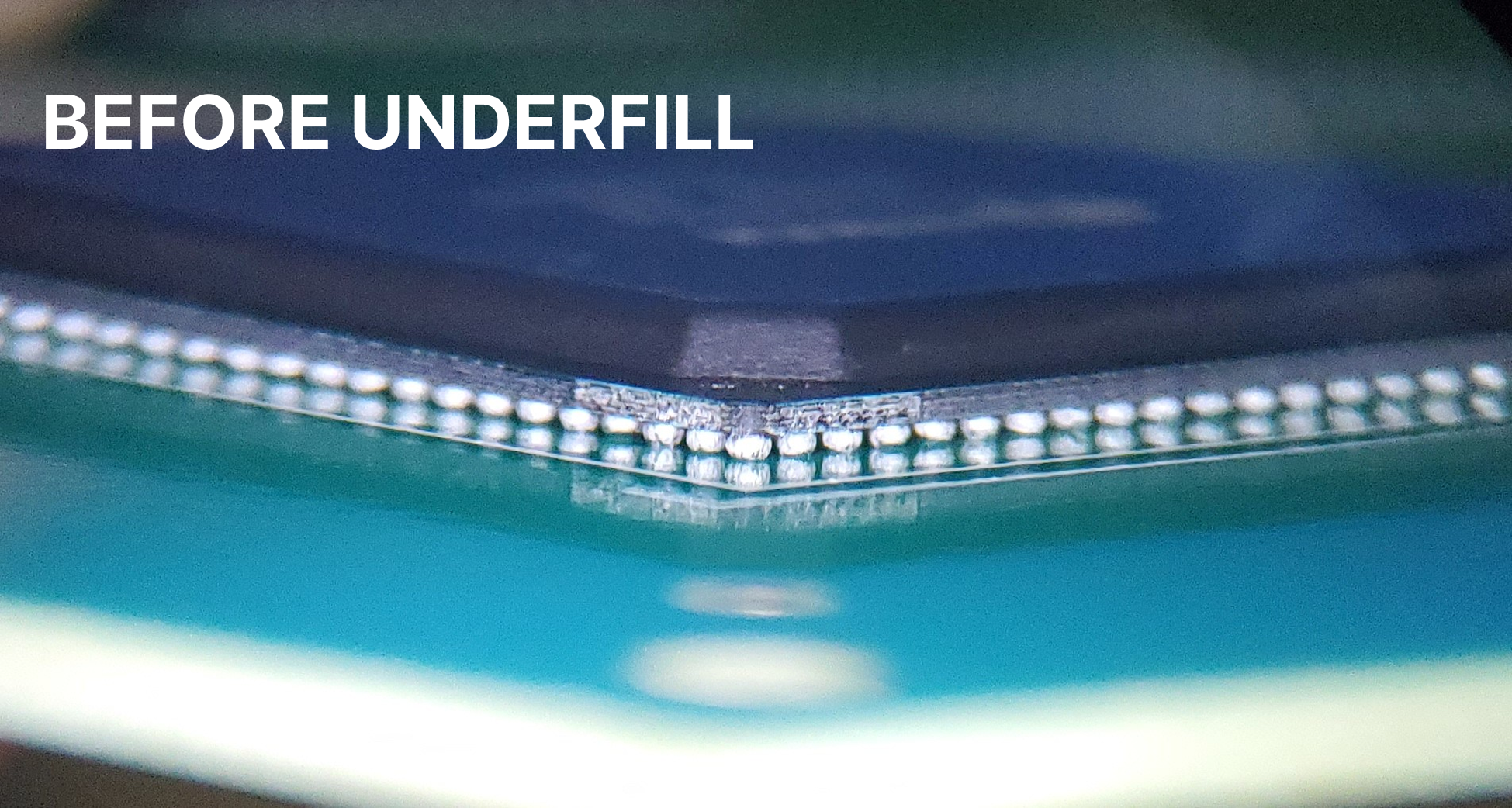
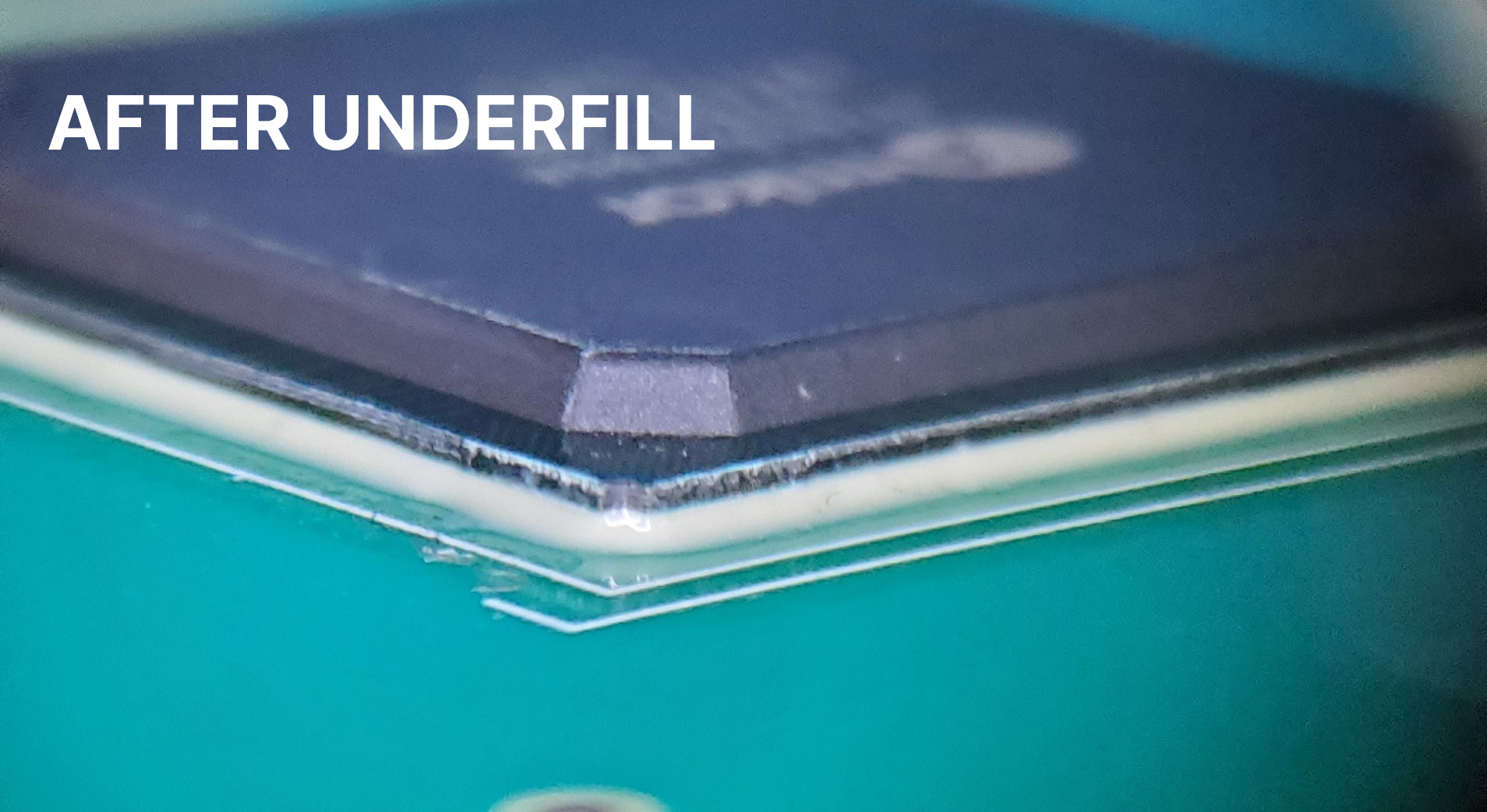
The solution strengthened the assembly, resolved the immediate qualification concern, and enabled the product to meet its reliability objectives. It also demonstrated the value of combining engineering problem-solving with disciplined manufacturing execution.
Beyond solving the immediate issue, the project delivered meaningful improvements in manufacturing performance and product confidence:
Improved resistance to environmental and mechanical stresses
Successful compliance with more demanding end-user requirements
Increased process consistency through automation
Reduced operator-to-operator variation
Improved manufacturing throughput
Enhanced process repeatability and control
Scalable production capability for future demand
Most important, the solution removed a critical barrier to qualification and gave the customer greater confidence in the product’s long-term field performance. Instead of facing redesign costs and schedule disruption, they were able to move forward with a more robust product and a production-ready process.
By resolving the reliability issue without requiring a product redesign, Impact ES helped the customer maintain program momentum, meet more stringent qualification requirements, and reduce the business risk associated with a high-visibility program. The engagement showed how the right engineering and manufacturing partner can protect schedules while improving product performance.
The value extended beyond the immediate fix. The automated process improved repeatability, supported future production scalability, and created a stronger manufacturing foundation for the customer as demand grows or requirements become more demanding.
This success story reflects the broader Impact ES approach: Bring engineering, process development, quality discipline, and manufacturing expertise together early to solve difficult problems faster and create measurable value for customers.
Customer challenges can often be solved faster and more effectively through engineering collaboration than through costly redesigns.
Root cause analysis and process evaluation can reveal practical reliability improvements that preserve manufacturability.
Automation adds value by improving consistency, repeatability, throughput, and scalability.
Integrating engineering thinking into manufacturing decisions helps reduce qualification risk and protect customer schedules.
Impact ES delivers value beyond build-to-print production by helping customers strengthen products, improve processes, and support long-term business success.
When qualification success, product robustness, and scalable production are all on the line, Impact ES brings the engineering depth and manufacturing discipline needed to help customers move forward with confidence.